Showing posts with label comics. Show all posts

Thursday, 26 March 2015

The Twisted Genius of George Feyer

It's been in the works for two years, but now I am happy to say that my profile of cartoonist George Feyer has been published in Canada's History Magazine. (April/May 2015 issue.) I suggest you buy/order a copy. You're in for a hell of a yarn.

Born into a privileged Hungarian Jewish family in 1921 he lived through both Fascist and Nazi regimes, experienced the brutality of the Siege of Budapest first-hand, then emigrated to Canada where he made his irreverent mark in the mid-century Toronto arts and culture scene - becoming best friends with Pierre Berton and chumming around with Marshall McLuhan, June Callwood and Peter Munk. But despite his out-sized talents and abundant potential, Feyer ended up dying  in Hollywood at the age of 47. 

Telling Feyer's story in such a high-profile venue is something of a personal victory for me. I've been reading the magazine for years and I'm told this marks the first time it's published a profile of a Canadian cartoonist, so that's good. But it's also because George and I go way back.

    
About 10 years ago, when I was working at the CBC Digital Archives, I was given a chance to tackle my dream job: to research, write, and produce an online feature about the history of Canadian comics and cartoonists. This involved weeks of combing through the CBC's TV and radio archives to find content that dealt with one of my favourite subjects, old comics.

At the time there was so little awareness of this part of our cultural history that I felt like I was a one-man guerrilla operation within the Mother Corps, labouring away passionately on a cause that few shared or understood. (One day, a CBC Archivist I was screening material next to asked what I was working on. When I said a feature about Canadian comics she visibly perked up, "Oh, that's great! I always loved John Candy!")

In the end, the project (The Comics in Canada: An Illustrated History) turned out great, and it's been nice in the decade since to see it and the footage I unearthed pop-up in unexpected places, and get referenced by the occasional historian. One of the highlights of the experience though was discovering this pint-sized, politically motivated shit-disturber who gleefully tore a strip off the stuffy arts and culture scene of 1950s Toronto.


George was a one-man art army armed with a felt-tip pen and a deeply dark Hungarian wit. His world view,  shaped by his experiences with religion and politics during the war, was best described by fellow Hungarian George Jonas as "central European gallows humour" and it coloured everything he did. Berton estimated that only half of Feyer's cartoons ever saw print, and even the ones that did were often toned down for mass consumption.

But even then his talent could not be contained by one medium. His knack for live-drawing (borne of necessity during his WW2 black market passport business) quickly gained him a gig as a personality on CBC Television, where he plied his trade mostly on the saccharine children's shows of the 1950s (see above). But he occasionally had the chance to use his skills for a more mature audience, like this 1964 clip from the current affairs show The Observer.

I quickly became entranced by this dervish, and began reading whatever I could get my hands on. Eventually I met his son, Anthony Feyer, at the 2006 Doug Wright Awards where George was inducted into the Giants of the North Hall of Fame. After chatting with Tony and learning more about his Dad's life, I knew right then that I had to tell his story.


Then, in 2013 I got an email from the editor of Canada's History Magazine asking if I had any ideas for a cartoonist profile. I pitched three, but I knew as I was preparing them that Feyer was the only choice. Next to him the others didn't stand a chance. His talent was soaring and years ahead of its time, and his sad, solitary end -- he was found dead after weeks in his apartment, owned by the ex-wife of James Mason -- was a heartbreaking punctuation to a life lived large.

His death crushed his family and friends and apparently cast a long shadow. Berton's 1975 book, Hollywood's Canada, The Americanization of Our National Image, is dedicated to his good friend, who died seven years before.      


And I feel like that shadow extends into the 21st century. His intelligent, jaded outlook and his ability to respond to current affairs with quickly-drawn comics seems a perfect fit for today's web comics landscape.

Anyways, I hope this background helps explain why I feel so inordinately proud of this piece. George was a singular talent whose story needed to be told. I'm honoured that he chose me to tell it. 


Tuesday, 23 September 2014

My review of 'Seth's Dominion'

Way back in 2006 I was asked to be interviewed for a NFB documentary about Guelph, Ontario cartoonist Seth. At the time I was working at CBC Toronto and doing freelance writing on the side, the latter of which served to introduce me to Seth. I had been reading his work for years but had only been introduced to him a few years before after I wrote an article about the historic/legendary weekly lunches that took place in Toronto between him, Chester Brown and Joe Matt (friends, and fellow cartoonists).

Anyways, during the 2006 Toronto Comics Arts Festival the very enthusiastic director Luc Chamberland asked me to answer some questions on camera for a film he was making about Seth. I agreed. Forty-five minutes, and many retakes later, I shook his hand and asked when I might expect to see the final product. "The ways things are going at the NFB these days it could take a few years," he said. Aside from seeing him briefly the following year when he filmed Seth's on-stage appearance with Chet and Joe at The Doug Wright Awards, that was the last I saw of him - or heard anything about the film. 

Then out of nowhere, this summer, news of the film's release bubbled up online. Not only was Seth's Dominion (great name) finally being released but its world premiere was happening at the Ottawa International Animation Festival, which was taking place in my hometown. Serendipity never felt so good.

So, last Friday I'm standing in the line-up outside the Bytowne Cinema when I notice a man dressed in a snappy hat and vest staring at me. No, it wasn't Seth; It was Luc. We quickly caught up, he thanked me for my interview and informed me that I made the final cut. Great, I thought. That means I have to watch a much younger version of myself on film (ugh) and I won't be able to pitch a review of the film. So I figured I'd just chime in on the old blog.
 
See, Luc is a very spiffy dresser

Before I do so I should say, for those who don't know, Seth and I have worked on a few projects together (The Collected Doug Wright being one of them) and co-founded the Doug Wright Awards together. That being said, knowing Seth and his work probably made me a tougher critic of the film - and I certainly had my concerns going in.      


Two things concerned me. One was the length of time it took to complete the film. I know I'm significantly different in 2014 than I was in 2006, and so was Seth. The other bigger concern was the use of animation. The road to adapting comics to cartoons is often a bumpy one, simply because people fail to understand that the two are different mediums that require a different skill set to effectively pull off. So when I heard that Luc had adapted some of Seth's comics into animated form I admit that I was nervous since in my experience the adaptation process more often than not loses something essential to the original comics.    

Luckily, any trepidations were quickly dismissed within the first five minutes of Seth's Dominion. The director wisely sets the tone for the film during the opening credits by having a clip of Seth expressing his amusement at the NFB's request to phrase his answers to questions "in declarative statements" only. This gets a laugh in early, but it also allows a bit of Seth's natural gregariousness to shine through; which serves as a counter-balance to the mostly serious subject matter that makes up most of the rest of the film. It also acknowledges the inherent but unspoken lie that rests at the heart of all documentaries; the notion that they are telling an objective truth, rather than engaging in story-telling.    


The rest of the film does a remarkably artful and efficient job of conveying Seth's life and career in a way that felt fulsome and fresh even to someone like me, who brings a robust understanding of the subject to the table. Chamberland leaves few stones unturned, exploring Seth's published comics work, his stamp diaries, his Dominion cardboard building project, his puppetry, his home renovations, and even his design work on his wife's barber shop. (There's even a great little in-joke waiting in that last part for eagle-eyed aficionados.)


The doc is divided almost evenly between on camera interviews with Seth and people who know him (Chris Oliveros, Chester Brown, Joe Matt, *me*, his wife Tania) and animated versions of his stamp diary strips. 

The interviews are insightful, especially Chester's, and it was a thrill (to me anyway) to see Joe Matt reemerge from the aether like some sort of grinning Ghost of Comics Past to comment of Seth's nature. (Which he does a very good and characteristically honest job of.) It would have been nice to see a few more interviews with the likes of Beguiling owner Peter Birkemoe or Jeet Heer, or any one of Seth's other cartoonist pals -- Chris Ware, Adrian Tomine, Dan Clowes, Chip Kidd, Ivan Brunetti -- but that's a minor quibble, especially given the constraints of time and budget.   


Then there's the animated segments, which I admit I was prepared to hate. Yet, when that little animated Seth pops up early on to explain the unique nature of the comics language I was immediately hooked. It turns out that Seth makes a perfect cartoon character. He certainly has the uniform for it. I mean, look at this:


His ever-present fedora and suit make perfect sense in animated form; even his voice -- with that trademark nasal twang -- is an ideal fit for a cartoon character. At one point it crossed my mind that he might have missed his true calling. 

The animated segments are done digitally (or "tradigitally", a new term i learned at the festival), which typically would leave me cold. But whoever animated these segments had a keen understanding of the morose, human engine that drives Seth's best work. The result are some of the most engaging cartoons I've seen in decades - and a true heir to the NFB's legacy of top-rate animated films.  


The tone here is flawless. Nothing is lost from page to screen; the music, voices and colours are bang-on, and combine to give the viewer a deep understanding of Seth's most powerful comics work. Then there's the simple "Wow" factor of seeing his comics come to life -- let's not discount the simple pleasures of life shall we?  

I was particularly excited to see the adventures of Kao-Kuk -- Seth's Inuit astronaut character from the pages of The Great Northern Brotherhood of Canadian Cartoonists -- come to life on screen. It was so good it left me yearning for a Kao-Kuk spin-off film (Luc, are you reading this?)  


While it's too early to gauge the general public's reaction to Seth's Dominion, based on the reception it got at the premiere I think it will appeal to Seth fans and non-fans alike. As a whole, it does a masterful job of gathering all of Seth's varied artistic outputs and presenting them together with a through line that taps into the heart of his artistic impulses. Fresh yet familiar, it's bound to please. And judging on the fact that it won the OIAF's Grand Prize for Best Feature, I'm sure you'll be able to judge for yourself once it screens in a theatre near you.   


As for my contribution to the doc, I suggest you do what I did: close your eyes and wince.


Sunday, 21 September 2014

George Feyer's stamp of approval


The other night I had the pleasure of watching the world premiere of Seth's Dominion, a long-awaited documentary from the NFB about the life and career of Guelph-cartoonist (and my pal) Seth. The doc is great -- no superlatives will really do it justice -- and I plan on reviewing it here soon. 

Director Luc Chamberlan has done a very good job of capturing the full breadth of Seth's artistic output, which includes comics, model buildings, puppets and his famous rubber-stamp diary. Based on a joke he told a fellow cartoonist, the rubber-stamp diary is exactly what it sound like: he had a set of rubber stamps made with some basic comic panels on them (him walking, smoking, working, exterior shots of his house). To spark his creativity he then stamps a page ion one of his notebooks with a random assortment of comic panels, then he fills in the word balloons to make a strip out of it. They're great. 

Here's a still from the film featuring Seth's stamps: 


The idea made me think of Canadian-Hungarian cartoonist George Feyer, who tragically killed himself in 1967. George famously had a stamp made up with the words "Horse Shit" on them in a Gothic script. Whenever he disagreed with somebody who wrote to him out came the stamp. It was a reply that was simple, brusque and outrageous (given the era). 

I recently wrote a profile of Feyer for Canada's History Magazine and during my research was lucky enough to come across a 1966 letter that he had applied his singular stamp to. I give it to you here as evidence of the power of Feyer's fiendishly iconoclastic nature. What a guy.      


Wednesday, 11 July 2012

A Smurf of a mystery


So, last summer someone made a 3D movie about the Smurfs, those little blue guys (and girl) -- and it made a lot of green. Like more than $560 million worth. That’s more than double Green Lantern and about $200 million more than Captain America. Not too shabby for a moribund Belgian comic. I spotted the DVD in a store the other day and it got me thinking about the surprising similarities between the enduring (and annoying) blue imps and the Brownies, a popular turn-of-the-century pop culture phenomenon by writer/cartoonist Palmer Cox.


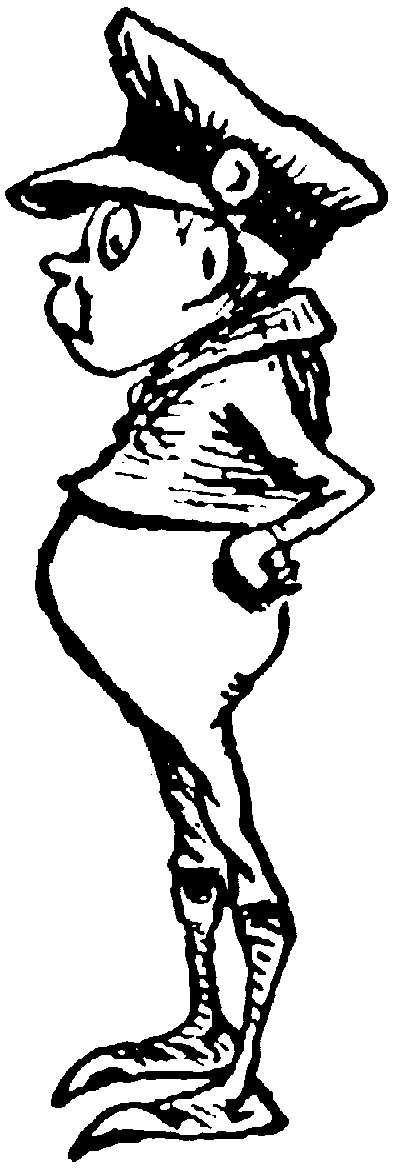
The Canadian-born Cox created the characters after hearing stories of Scottish/Irish "brownies", mischievous little elvin creatures who would help humans at night. They first appeared in book form in 1883. A secretive society of all-male sprite-like creatures who pulled pranks and occasionally helped out humans, they were easily identifiable thanks to their one-note personalities. Some favourites: Chauncey Quoter (a poet), Major Telloff (an army commander) and Cholly Boutonnière (a top-hatted dandy). Heck, they even sported little peaked caps.


I know, right? I can’t be the only one to connect the dots on this can I? The fact that Cox died in 1924 and Pierre Culliford, the creator of the Smurfs, was born four years later lends at least some credence to the possible connection. Cox's books enjoyed multiple reprints for decades after his death, and were translated into many langugaes, so it's possible that a young Culliford would have been exposed to them. 

Keep in mind, though largely forgotten today the Brownies were wildly popular, with their adventures being translated in multiple languages and many products being sold with their image attached. Ever hear of Kodak’s Brownie camera? Yep -- an early example of sponsorship. I can’t find any info online that suggests Culliford (aka Peyo) used The Brownies as inspiration for his little men (and one woman), but it sure is fun to speculate.

Monday, 27 February 2012

My review of 'The Someday Funnies'

So, after more than three decades The Someday Funnies was finally published last fall by Abrams Comic Arts. I reviewed it in this weekend's Globe and Mail.

I was anticipating this book as much as anyone, thanks the romance of its backstory and its treasure trove of lost comics riches from the likes of Harvey Kurtzman, Justin Green, Kim Deitch, C.C. Beck and Art Speigelman.

But, then it came out.

As I detail in my review, this massive book is flawed in a number of fatal (and regrettable) ways. One of the books most aggravating flaws (that got trimmed from my piece) is the intrusive and unfunny cartoons of editor Michel Choquette that are conspicuous throughout the book. Imagine trying to read, say, Maus or Clyde Fans and having a tiny avatar of Art Speigelman or Seth pop up IN THE MIDDLE OF A PANEL, and you'll understand how annoying this trope is.

It speaks to a failure to understand the medium of comics itself. Why else would you foist a trope like this on art that people have been waiting decades to see in print? Who knows?

Hopefully maybe someday -- 40 years hence -- an ambitious editor will publish thsi product in an "artist's edition" (like these from IDW), devoid of shoddy colouring job, confusing layouts and "pop-up" cartoon editors. 


Tuesday, 21 February 2012

Kurt Cobain, burgeoning comic artist

Young artist Kurt Cobain draws inspiration from Marvel Comics Giant-Size Werewolf. From Cobain Unseen.

Friday, 9 December 2011

Back when comics were really, really cool


A Brooklyn gang member poses in front of a rack of comic books, c. 1959 (courtesy Retronaut)

Tuesday, 29 November 2011

Another look at 'Now You're Logging'

After too many years, I have finally got around to writing an appreciation of Now You're Logging, a great long-gone graphic novel by the B.C. outdoorsman-turned-cartoonist Bus Griffiths. The essay (with art) is now up at The Comics Journal.

As I say in the piece, this book has haunted me -- in a good way -- for the better part of a decade, ever since Seth and Peter Birkemoe first told me about it. To describe it as being "out-of-print" seems like a half-measure: this book has been neglected. Among the first verifiable graphic novels in Canada (it started as a serial in a Canadian Whites comic during the Second World War), Now You're Logging is a wonderful hand-made gem of a comic that surprises and charms the reader on every other page. 


Griffiths was a self-taught artist, which is often a disaster when it comes to constructing good comics --but in this case his lack of formal experience resulted in a refreshing, innovative approach to the medium. His goal here was to create an accurate document of logging in the 1930s, before machines, when men climbed hundreds of feet in the air to lop down trees. His sheer devotion to this should be enough to make this book a classic, at least in Canada where its set. Heck, I'd be happy even if folks in British Columbia showed this book some love. But it's not the case: it's simply fallen off the edge of cultural relevance. For years now its publisher Harbour Books has maintained a Now You're Logging page on its website, despite the fact that the book is out of print. Good luck finding an affordable copy online.     

You've got to wonder what Griffiths would think about his life's work being allowed to fall out-of-print for so damn long.

Monday, 21 November 2011

Review of 'The Death-Ray' in The Globe and Mail

 Like you, I love me some Daniel Clowes. In the past decade or so the creator of the epochal alt-comics series Eightball has rightfully scaled to the summit (or close to it anyway) of literary comics, where he has proceeded to produce some of the medium's most thought-provoking works of art. Whether it's Mister Wonderful, Wilson, Ice Haven or Ghost World, the Clowes seems to have genuine insight into the human soul.

He even knows how to write good super-hero stories, as evidenced by his latest book The Death-Ray, which I reviewed this weekend for The Globe and Mail


And I agree whole-heartedly with that headline. If this book isn't the last word on superhero comics for you I'll eat my cape. 

Thursday, 13 October 2011

Kid Koala profile in Mcgill Alumni magazine

 My piece on Montreal-based DJ and cartoonist Kid Koala is now up on the McGill University Alumni magazine website. I was a big fan of his music, say mid-90s, but had lost track of him so this was a great opportunity to play catch up.

Like most of us, he's done some growing up: he's married now with a three-year-old daughter. His music and art have matured a lot as well, with his new book and CD Space Cadet, turning out to be a real gem. Thoughtful and moving, it's been on steady rotation in my office and living room. He's touring it right now, so go check it out!


NOTE: Tomorrow I leave for an 11-day trip/work assignment in Ethiopia. Keep your eyes peeled on the blog for itinerant updates and pictures from the savannah. Wish me luck!


Friday, 7 October 2011

CBC TV spotlights Drawn and Quarterly comics

Every now and then life allows me to do some fun things. Like the Doug Wright Awards, which writer-director-actor Don McKellar has helped out with the past couple of years. This summer Don asked me to lend a hand with finding some comics that he could incorporate into a new TV series he was directing in Ottawa (my hometown). The show, Michael: Tuesdays and Thursdays, is about an anxiety ridden young man and his relationship with his therapist, who also has his own neuroses. So far, it is very funny and charming.

Part of a recent episode deals with Michael having a gal over to his apartment, which is decorated with many geeky accoutrements, including posters for alt-comics. Spotlighted in the episode are Yoshihiro Tatsumi's Black Blizzard and Joe Ollmann's Mid-Life. 

The episode may contain the only joke I have ever seen that is built upon a knowledge of the comics of Tastumi.

(Many thanks to Drawn and Quarterly for securing the permission to use these.)


Friday, 12 August 2011

When Ira Glass met Wolverine and Nightcrawler


There is certainly no shortage of improbable crossovers in superhero comics. But this bit of cross-promotion between Marvel and NPR's program This American Life may rank near the top of the list:


This is a limited-edition print that TAL is currently selling on their website. The art is taken from a recent X-Men comic featuring art from Michael Allred. At some point the story features Wolverine and Nightcrawler on a road trip, during which they tune in to a broadcast of This American Life. That word balloon features host Ira Glass doing his familar intro:


The theme this week? Corporate Synergy!


Wednesday, 10 August 2011

'The corporation badly needs to be shamed into doing the right thing", Seth on the Marvel boycott

Over at his Mystery Hoard blog, Bryan Munn has posted an original essay from Seth about the simmering Marvel Boycott that Steve Bissette launched last week. It all comes down to a recent court decision that dismissed a suit by Jack Kirby's heirs that was seeking to get copyright on some of the characters and concepts that he created for Marvel in the 1960s.

These include The Fantastic Four, the Incredible Hulk, The Avengers, The X-Men and Captain America. (That's a great list -- and I didn't even include Devil Dinosaur in there.) Marvel, which is owned by Disney, refused to even consider the fact that Kirby --- the inexhaustible engine behind most of their most enduring "properties" --- might be deserving of more than what he got during his time working for the company.


Bissette is calling for a boycott of all Marvel products, including comics and any of the movies that are currently running rampant in a multiplex near you. Seth chimes in on this, and supports the fledgling movement 100 percent; even saying that he'll never work for the company until they gives Kirby his due:

I am certainly in favour of it. I hope it catches fire and spreads. The corporation badly needs to be shamed into doing the right thing.

Admittedly, it's a pretty symbolic gesture on my part. I cannot even recall the last item I purchased from the corporation (maybe a Marvel Masterworks volume or something of that sort), nor have I ever worked for them. I certainly won't work for them in the future either until something is done to right this wrong.

Seth admits this is a largely symbolic gesture on his part, as he's never worked for Marvel, but symbolic or not --- it's still significant.

He also makes a suggestion for Marvel Maniacs: spend your dough on back issues of classic Marvel comics. That way you support the classic comics, but avoid giving your cash to a greedy corporation.

Sounds good to me: count me in. 


Sunday, 1 May 2011

'Paying For It' review in The Globe and Mail (plus a bit of back-story)

My review of Chester Brown's contentious new book, Paying For It, ran in The Globe and Mail Saturday. Even though the book just hit shelves, there have already been some great reviews of it including Sean Rogers over at The Walrus and Tom Spurgeon's at The Comics Reporter.

As I was writing mine, it dawned on me that I had helped draft a letter to Chester years ago to express outrage over a storyline in his comic series Yummy Fur that dealt with pornography. I thought the comparison of my outrage and what is sure to be current reader outrage kind of made sense. After I filed my review I dug up my old issues of YF and found the one that included the letter I remembered writing; it was issue #24 (featuring my favourite stand-alone Brown story "The Little Man").


To my surprise, the letter I recall writing with my girlfriend at the time bore no evidence of my involvement. In fact, my name was nowhere to be found.


Pretty embarrassing, especially since I had just openly admitted in a national newspaper to writing this letter -- when I could have just blamed it all on my girlfriend and walked away Scot-free. But the truth is, I distinctly remember writing this letter with Joanna -- i even remember the insane Christmas card we wrote it in (there was a feather on it). I think at some point we must have decided the message would hold more weight if it came from a woman. Go figure. 

Still, these words pretty well sum up my proto-feminist point-of-view at the time. What can I say? It was the early 90s and I was a university student. Sigh.

Anyway, there's the truth of the whole sort-of sordid matter for you.

Thursday, 14 April 2011

Getting dressed by Seth

Contrary to what you may believe, my involvement in The Doug Wright Awards is not all parties, showgirls and celebrity hobnobbing. Most of the time it's a lot of grunt work, anxiety and stress. Which is okay; after all, no one was exactly begging me to start up a Canadian comics awards back in 2004. So I can't/shouldn't gripe, right?   

Still, it can be a lot of work sometimes. Then there are times when it seems to all pay off; like today when I received an unexpected package in the mail from Seth (the "Creative Director" of the Awards).

As you probably know Seth designed a lot for us over the years, starting with our distinctive awards to a set of buttons and even a t-shirt. So it shouldn't have surprised me when I opened the package and found this:


According to the note included in the package, this is the official Doug Wright Awards club jacket to be worn by the organizations director (me) on the night of the awards ceremony. The plaid tie came with. Talk about spiffy! The image on the breast pocket is an embroidered version of our new logo which will debut on our new website in the coming weeks):

   
You know, the last time I was told how to dress I was about 10-years-old.  But somehow, I'm willing to make an exception in this case. Thanks Seth! 

Tuesday, 12 April 2011

A lost monument to a comic strip of the past

I suppose I should have saved this post for Canada Day, but the guys over at Sequential compiled a thoroughly satisfying post today about Canadian cartoonist landmarks that roused me from my lazy blogger tendencies. Is there anything more satisfying than a statue or structure to a once-great comics character? They serve as permanent reminders of the profile these characters once enjoyed, even long after their cultural gravitas has waned. Just think of Chief Wahoo (who is based on the 1940s comic strip character Big Chief Wahoo) or,my personal favourite, Hamilton Tiger Cats mascot/booster Pigskin Pete who is the direct descendant of Jimmy Frise's boisterous Birdseye Center character Pigskin Peters.      


All of this got me thinking about a great lost monument to Birdseye Center, made by Frise's replacement on the strip, Doug Wright. On top of being a master artist, Wright was also an obsessive model-maker. During the research for The Collected Doug Wright Volume 1 I heard stories of his model plane, cars and trucks -- all made from scratch in his spare time. So it only made sense that after inheriting the popular strip from Frise, he would eventually turn his model making to the strip's fictional namesake.


At some point in the 1950s, Wright turned his obsession to Frise's great creation and built a scale model of Birdseye Center (which had become known as Juniper Junction due to copyright issues). The model (seen below) featured "Noazark" (a sightseeing ship/tourist trap), a dock building and a structure that looks to be the town hall.    


For comparison's sake, here's a Juniper Junction strip as drawn by Wright depicting the sink-prone  "Noazark".


I was lent the picture by Phyllis Wright, Doug's widow, who told me that he passed the model on to a neighbourhood teen after the strip came to an end in the late 1960s. That was very kind of him, if a bit foolhardy. The teen eventually grew up and grew tired on the model and threw it out years later. Egads, that shattered a little piece of my soul! But at least Wright was smart enough to take this picture, which remains the last evidence of a great comics -- if little-seen -- monument to Canadian comics history. 

Monday, 21 March 2011

John Porcellino gets animated

"The Next Day" is the latest project from Canadian multimedia upstart Pop Sandbox, the guys behind last year's graphic novel (and soon to be documentary) Kenk. That project was fortunate enough to have as its subject matter a highly controversial bike-thief/convict/urban legend, Igor Kenk, which helped it generate a truck-load of publicity.  

Their latest project tackles the somewhat weightier (and perhaps harder-to-sell) subject matter of suicide. What really caught my attention about The Next Day graphic novel is that it will feature art by  John Porcellino, the legendary minimalist cartoonist behind King-Cat Comics (which have been collected as King-Cat Classix, Map of My Heart, Diary of a Mosquito Abatement Man and Perfect Example). The book itself looks great, with Porcellino's simple line-work paired nicely with the first-person accounts of depression and attempted suicide. (Here's an excerpt.)

But what really perked up my ears was a trailer I just saw for an "interactive documentary" that Porcellino has apparently worked on, that expands on the subject matter in the book. It's a blissful, haunting little clip that brings John's art to life perfectly:                 
 

The Next Day - Trailer from Pop Sandbox on Vimeo.

Looks great, no? I want to say this is the first time his art has been animated, but that just seems wrong. Surely this can't be the first time?

Thursday, 10 February 2011

Michael DeForge gets animated

I don't know what it is with animation lately, but I've been stumbling over some odd stuff in the past week or so. Like this disturbo bit of animation from Toronto tour-de-force cartoonist Michael DeForge. Set to an old Elvis track, I think the characters in this have something to do with Wet Cough, his fine 2010 mini-comic. I can't get enough of this guy:   


Michael is doing something special for this year's Doug Wright Awards that I can't really reveal yet --but I am really excited about.

Sunday, 30 January 2011

The many (weird) faces of Curt Swan's Superman

If you know me at all, you know I like my superhero comics old and boring. As in Wayne Boring, Kurt Schaffenberger or, best of all, Curt Swan. Thanks to those Blue Ribbon cheapo reprints of old DC comics that were around in the 1970s, these guys defined Superman for me, as he should be: lantern-jawed, broad-chested and incapable of expressing human emotion.

There was something about the 1950s-era Superman of Swan that was almost right. Just-about-perfect, yet somehow charmingly stilted. So imagine how pleased I was as I was flipping through this behemoth of a book called DC Comics Year by Year: A Visual Chronicle and came a cross this wonderfully odd two-page spread of what looks to be character studies (or maybe an artists' guide?) of Kal-El by Mister Curt Swan himself:      


What a great find, right? More than two dozen head shots of Supes in various states of awkwrad emotional distress. But, like any good 1950s Superman artist, some of the emotions are hard to parse.

Take this one for instance:


Is the Last Son of Krypton shocked here? Surprised? Without a story or word balloons, the mind struggles to pin it down, right?

Then there's this pair:


Is that a knowing jovial wink, or something more -- ewww -- flirty? GROSS! And what's he doing on the right?? I odn;t even want to think about what's happening off frame....

But my fave head shots of the bunch has to be this trio:


I know that first look! That's the unmistakable look of someone who's just eaten at a Taco Bell, Number Two could be a whole host of things, but it looks to me like the Man of Steel's heart is getting just a little crushed (Jimmy Olsen probably got a real job in a better city). Then there's that last one, which is probably supposed to be Supes soaking up the life-giving rays of Earth's yellow sun. Yes.

Er.....


Best not to ponder this one too much. I imagine Swan didn't, so you shouldn't either.

What was my point again? Yes, Curt Swan is the Greatest Superman Artist Of All Time, Period; in part because his art was just slightly off. He was 90 percent there most of the time, but there were plenty of times that Big Blue just looked kind of odd. Which is a better batting percentage of most artists these days, who seem to have two or three standard expressions. Maybe this was intentional! Perhaps Swan figured that Superman was an alien, and would therefore never be fully at ease with humans. Thus, the weird expressions. (It coulda happened!) 

Whoever your favourite Superman artist is you owe it to yourself to give this book a look. It takes 75 years of DC Comics history and spends a few pages on each exploring the important characters, events and creators that marked that particular period. (It starts with New Fun #1 in February 1935.) As it suggests in the intro, flip to the year you were 13 and read those pages first -- since this is supposedly the age that most kids get into superheroes.

It's a hell of a lot of fun -- and worth a look.